Search This Blog

Showing posts with label South Indian farmers. Show all posts

Wednesday, March 19, 2014

Veerappa Moily claims that he has not approved any field trials, when confronted by farmers

South Indian farmer organizations, led by KRRS march to Veerappa Moily's House to protest field trial approvals
Bangalore, 18th March, 2014: When confronted by scores of farmers of the Karnataka Rajya Raitha Sangha (KRRS) and South Indian Coordination Committee of Farmers’ Movements (SICCFM), from four states of South India, Veerappa Moily, the Union Minister for Environment and Forests, today claimed that ‘as far as his knowledge goes, he had not approved any field trials of GM crops’ (1). The farmers had gone to demand that the permission he gave to the regulators to go ahead with clearances for GM field trials be revoked and that he also explain the fresh basis on which he reversed his predecessor Jayanthi Natarajan’s decision to suspend approvals given by GEAC.  Moily told the protestors that “he had only looked at the file and returned it” and did not approve any trials.

Union Minister for Environment and Forests listening to the concerns voiced by farmers against GM crops

“We are not sure if Veerappa Moily is telling the truth or only presenting smart lies in front of us. If this is indeed true that he only looked at the file and returned it, this means that Genetic Engineering Appraisal Committee (GEAC) which is meeting on March 21st 2014 to give further approvals for GM crop trials should not give any clearances, since the earlier Minister’s orders will still be binding on them. Jayanthi Natarajan, in her letter to the Prime Minister dated 9th July 2013 (2) that she had ‘felt it important to await the final judgement of the Supreme Court in this matter, and particularly with a view to avoid any disrespect to the Hon’ble Court directed that further proceedings may await the decision of the Supreme Court’ (which incidentally is on April 15th) – which means that this view of the Minister has to continue to prevail on the regulators”, said Mr. K. T. Gangadhar, President of Karnataka Rajya Raitha Sangha.


Farmers marching towards Union Minister Veerappa Moily's house to protest against field trials of GM crops

Earlier in the day, scores of farmers of the Karnataka Rajya Raitha Sangha (KRRS) and South Indian Coordination Committee of Farmers Movements (SICCFM) staged a protest march and sit-in at the residence of Veerappa Moily in Bangalore. This was in response to the recent announcement by the Minister in a press conference in Delhi (on 27th February 2014) to permit hundreds of field trials of GM crops including GM varities of rice, wheat, maize etc across the country. The decision had been widely condemned by farmer unions, civil society, political parties etc, given the growing evidence of adverse impacts of GM crops to farm livelihoods, human health and environment.

“This is a clear turnaround from what the Minister announced in Delhi and seemed to have done, in terms of giving a go-ahead to the 117th meeting minutes of the GEAC. If he is hiding behind semantics by saying that he did not clear field trials, we want to warn him that we will come back in greater numbers to protest these lies from him. If he is speaking the truth that he has not made any file notings at all or give clearances, we want him to give express instructions now to the regulators not to clear any trials in the upcoming meeting, given the amount of confusion prevailing on the subject”, said Chukki Nanjundaswamy, working president of KRRS.

Farmer leaders addressing the gathering about GM crops and its adverse consequences


“GM crops are the latest tools in the hands of Multinational seed companies to take control of our seeds. The decision by Moily to permit the experiments of these risky GM seeds of various companies like Monsanto, Syngenta, Bayer, Dupont etc in our farms across the country shows that our governments are hand in glove with them in making that happen” said Kannaiayan Subramanian of SICCFM.

Addressing the farmers Badagalpura Nagendra, General secretary of KRRS stated that “It is unfortunate that such GM crops are being mindlessly promoted by the central and state governments even after the repeated failure of Bt cotton, the only GM crop approved for commercial cultivation in the country. There was massive failure of Bt cotton reported in Karnataka in the last season which was acknowledged even by the Agriculture Minister in the Karnataka state assembly. However, the compensation announced was measly and inadequate. The tragedy is that companies like Monsanto who own the Bt technology walk away with thousands of crores of Rupees earned as royalty from Bt cotton seed sales while the farmers are pushed to suicides. We want to warn the Karnataka government not to give any NOCs to field trials here; otherwise, farmers will be forced to ensure that these trials are cremated”.

The announcement by Moily late last month received flak from state governments including the Congress ruled Kerala government. The Chief Minister of Tamilnadu responded by saying that she will not permit field trials in her state.

Various state govts besides kerala and Tamilnadu, like Bihar, West Bengal, Odisha, Madhya pradesh, Chattisgarh and Rajasthan had denied permissions for field trials in the past. Hailing the recent statement by the Tamilnadu Chief minister J Jayalalitha to keep the state free from GM crop trials  P.Suresh Kumar of Katchi Sarpartra Tamizhaga Vyavasaigal Sangam said that “agriculture is a state subject and it is unacceptable that the central government continues to peddle GM crops despite opposition from state governments.”

Those gathered also pointed to the reccomendations by the parliamentary standing committee on Agriculture which in its report submitted in 2012 highlighted the various concerns with GM crops and the inadequacy of its regulation in the country and strongly reccomended against any open release of GM crops including for field trials as they could lead to irreversible contamination of seed and food supply. The Supreme Court appointed Technical Expert committee had also given similar recommendations last year.

“GM seeds are not just a threat to seed sovereignty of the country but also food safety and sustainability of our environment and they have no place in our country. Experiences with field trials both in the country as well as in other parts of the world shows that they can contaminate our seeds and food supply chains ” said Davison of Kerala Coconut Farmers Association. He further stated that “It is nothing but vested interests to promote GM crops when it is so clear that science and society are against it”.

KRRS and SICCFM declared that they will step up the campaign against GM crops and their promoters in the coming days, that this will be made into an election issue and that will not permit even a single field trial to happen in the state. They urged the Chief Minister of Karnataka to stand by the will of the people and deny any permission for such risky experiments in the state.

Notes to the Editor.
 1. The video link of Veerappa Moily's statement to farmers is available at http://youtu.be/fCxRuUuW3zY (English      video),  http://youtu.be/n6O6W31T2M0 (kannada video)
 2. The letter by Jayanti Natarajan to the prime Minister is available at  http://indiagminfo.org/?attachment_id=680

Saturday, February 8, 2014

The aftermath of the WTO Bali Minesterial and other Current Farming issues that concern You

Farmers in India and most developing countries are threatened by many internal and external forces. Industrialization is seen as the only way for a country to ‘develop’ and in this mindless frenzy, the vital role played by farmers in sustaining an entire population is largely ignored. Governments are obsessed with GDP, businesses with profit and the media with the Western way of life. Farmers and agriculture are deliberately and successfully kept hidden from the general public.

Hence, the South Indian Coordination Committee of Farmers’ Movements (SICCFM) met at Cochin, Kerala on the 25th and 26th of January in continuation of their efforts to collectively address issues of farmers belonging to the five states of Maharashtra, Karnataka, Andhra Pradesh, Tamil Nadu and Kerala together. The participating organizations were:
  • Karnataka Rajya Raitha Sangha (KRRS) from Karnataka
  • Tamilaka Tamilazha Vivasayikal Sangham (TVS), Katchi Sarpartra Tamiliga Vivasayigal Sangam, Uzhavar Ulaippalar Katchi and Tamil Nadu Vyavasaikal Tolilarkal Munnetra Sangham (VTMS) from Tamil Nadu
  • Shetkari Sanghatana from Maharashtra
  • Kerala Coconut Growers’ Association from Kerala
  • Food Sovereignty Alliance from Andhra Pradesh
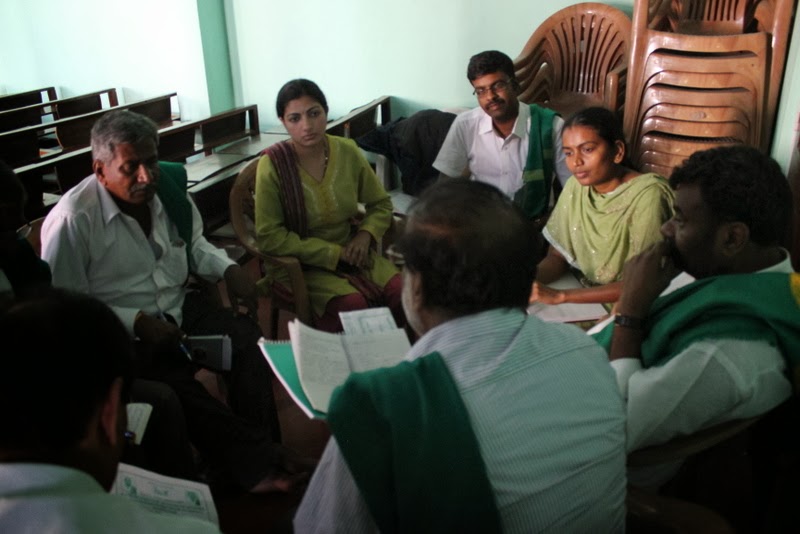
South Indian farmers at the SICCFM meeting
SICCFM general secretary Kannaiyan addressing the gathering
Each state had different issues but some cut across all boundaries: cheap food imports, rising costs of agricultural inputs, farmers driven to suicide, land grabbing by the Government and companies, loss of traditional crop varieties, corporatization of food and milk and finally, climate change.

South Indian Farmers at the SICCFM meeting
The different States engaged in discussion at the SICCFM meeting
Some specific concerns of each state were:

Maharashtra felt the need for a Sustainable Agriculture committee to provide training and support to farmers wishing to make the transition from high cost to natural farming.

Farmers' representatives from Maharashtra with Afsar Jafri at the SICCFM meeting
Farmers' representatives from Maharashtra with Afsar Jafri

Andhra Pradesh strongly called for the protection of forest rights, traditional seeds and customs. Since corporatization of milk production has already begun here, there is a need to organize mass protests against the IFFCO and Fonterra joint venture to produce top-quality milk for premium customers. This would destroy the livelihoods of thousands of local dairy farmers. Another important issue is the acquisition of land for Special Economic Zones (SEZ) mushrooming around the capital city of Hyderabad.  

South Indian Farmers at the SICCFM meeting
Leaders from the Food Sovereignty Alliance, Andhra Pradesh exchanging ideas

Tamil Nadu presented the following demands: persuading the government to purchase coconut instead of copra, making MNREGA mandatory for farmers, allowing toddy tapping, banning the import of oil rich coconut cakes, encouraging ethanol production from sugarcane and creating a separate agricultural budget which would fix scientific prices for milk and other agricultural produce.

South Indian farmers at the SICCFM meeting
Tamil Nadu farmer leaders deep in discussion

Kerala, which has faced severe issues with the pesticide endosulfan appealed to leaders from Karnataka and TN to educate their farmers to discontinue its use, which was still being sold under different names.

South Indian farmers at the SICCFM meeting
President of the Kerala Coconut Farmers' Association, Ravindranath actively listening

Karnataka has seen a steep rise in farmers’ suicides and hence leaders recommended an Anti-suicide Cell to be established, whose members shall include the District Commissioner (DC) and the Additional DC. The Cell would persuade the government to increase the compensation from 1 lakh to 5 lakh, compensate women farmers, provide for children’s education and offer a job to the next member of family. In the event of natural calamity, the government should compensate farmers for loss of crop by the gross loss suffered by the farmer and not the net loss.

South Indian farmers at the SICCFM meeting
Farmer leaders, students and volunteers from Karnataka

 A common issue that bothered farmers across South India was the two reports on the conservation of the Western Ghats: the first being the Prof. Madhav Gadgil headed Western Ghats Ecology Expert Panel (WGEEP) report and the second being the Dr. Kasturirangan headed High Level Working Group (HLWG) report. A Professor from Cochin University was invited to share his views and he praised the Gadgil report as it benefited the poor, tribals, farmers and the environment while the Kasturirangan report was against all the above and instead promoted industries, tourism, hydro and wind energy projects. Pannaga then presented the key features of both reports, reinforcing Professor’s stand that farmers in the SICCFM should support the Gadgil report and voice their serious discontent against the Kasturirangan report. Selvaraj from VTMS who works in the Niligiri biome commented on the difficulties in implementing the suggestions given by the Gadgil report.

Roundtable on the WTO Bali Minesterial

Two organizations from Delhi, Focus on the Global South and South-South Solidarity, working on strengthening the position of developing and least developed countries (LDC), were invited to shed light on the aftermath of the WTO’s Bali Minesterial that took place in December 2013.

Afsar Jafri from Focus on the Global South gave a brief background of the WTO, how it was dormant from 2005 to 2013 but got a new lease of life at Bali. India’s Commerce Minister, Anand Sharma, though initially supported developing countries, soon gave in and accepted Trade Facilitation and the Peace Clause. Trade Facilitation is the automation of our ports and reducing Customs procedures to ease the entry of foreign goods. Peace Clause is the small window of time given to developing countries to subsidize food procurement (even beyond the specified limits of 10% de minimis allowed to India and other developing countries) for their country’s food security programme. During this period, if a country exceeds its subsidy limits, other members of the WTO could not take the defaulter country to the WTO’s Dispute Settlement Body. The Peace Clause also places many data reporting and other restrictive conditions that in effect, India may not even be allowed to implement its Food Security Act. It is an interim solution and developed countries would try to extract more from developing countries by pushing forward proposals on Singapore issues in the permanent solution, completely ignoring the Doha development round issues which have provisions to correct some of the historical injustices in the WTO.

Afsar Jafri from Focus on the Global South at the SICCFM meeting
Afsar Jafri speaking about the WTO and its dangers

The classification of subsidies under different coloured boxes was also explained, which clarified how developed countries could cleverly provide billions of dollars of subsidies, while categorically preventing developing and LDCs from spending even a fraction of that amount.
Afsar also exposed the fraudulent figures of the $1 trillion boost to the global economy and the 20 million jobs that the Bali package would create, as fictitious numbers projected by developed countries to lure developing countries to agree to Trade facilitation agreement. It does not include the costs that developing and least developed countries (LDC) would incur to implement the agreement’s provisions. He concluded with a call for action against the WTO and the Free Trade Agreements (FTA) that are being enthusiastically promoted by the rich world.

Following Afsar’s insightful talk, Benny Kuruvilla from South-South Solidarity expanded on the dangers of Trade Facilitation. Trade Facilitation was one of the 4 Singapore issues which were rejected by developing countries at the 2003 Cancun Ministerial. Despite this it was strategically inserted as an issue on which modalities could be discussed in the July 2004 Framework Agreement. And now it has been adopted as the first major agreement at the WTO since its founding in 1995. If one examines the content of the agreement, it is basically an issue of importance to developed countries and will facilitate more imports into developing countries.

This is dangerous for countries such as India as it would widen the trade and Current Account Deficit (CAD) by allowing more imports. The agreement basically calls for developing countries to harmonise standards – on issues such as customs processing, shipment procedures and invest in costly trade facilitating infrastructure which will also include consultancies. It is also a costly exercise and funds reserved for the social sector could be diverted to implement it. Customs duties and tariffs are an important source of revenue and developed countries are forcing India and other developing countries to remove them. He gave some hope to farmers in that there is time till July 2014 to ratify the Trade Facilitation Agreement. This is an opportunity to mobilize people’s movements to fight against this as well as the bad outcome on food security.

What you can do

India’s urban populace currently oblivious to where and how their food is produced, needs to wake up to these burning issues. You could start by acknowledging the role played by our farmers who ensure you have enough to eat. An important way to do this is to find out the source of your food and choose the local variety instead of imported alternatives. All processed food have their place of manufacture printed on their labels. For fruits and vegetables, it is more obvious because the vendor himself will proudly announce the 'foreign' country of origin. By choosing local produce, you not only support our farmers but also prevent the enormous carbon emissions related to transport. It also ensures you get food that is naturally fresh, instead of that which has artificially been kept fresh through the long distance travel.

The time has come for you to exercise your right of choice and choose food that’s grown in your country by your farmers.