Search This Blog

Sunday, October 27, 2019

Peasants and Small scale food producers in India intensify their protest against RCEP free trade agreement


Peasant movements carry out coordinated demonstrations outside several district headquarters across India.

On 24th October and thereafter, thousands of farmers organized under the Indian Coordination Committee of Farmers’ Movement (ICCFM) and ally groups carried out coordinated actions and demonstrations outside several district administrative headquarters in Karnataka, Uttar Pradesh, Tamil Nadu, Madhya Pradesh, Punjab, Haryana, Andhra Pradesh, Telangana, and Kerala. Farmers union staged coordinated protests across more than 50 places in the country demanding the Central government to keep agriculture produce and dairy sector out of the purview of Regional Comprehensive Economic Partnership (RCEP) pact.

Through these joint actions, they were registering their protest against the Union Government’s decision to sign onto RCEP – the Regional Comprehensive Economic Partnership Agreement – a trade deal involving India and 15 other nations in the Asia Pacific. 

RCEP is touted as the world’s biggest trade deal and farmers in India point out that its an agreement shrouded in secrecy, despite threatening to impact the country’s dairy sector and the autonomy that the farmers have over seeds. They allege that while the Indian government, held consultations with several Corporate bodies to allay their concerns, it has held no negotiations with any of the farmer’s representatives so far. 


Over the last week, several state governments and opposition parties in India have also held press conferences and public meetings rejecting RCEP and urging the Union Government to safeguard the interests of India’s farmers and rural workers before opening up the country to further competition from ASEAN countries as well as big economies like China, Japan, Australia and New Zealand. 

“As the date for Prime Minister Narendra Modi’s proposed visit to Bangkok draws near – he is expected to be in the Thailand capital on November 4 –  the objective of his planned trip to the Asian country has left the agrarian community, the dairy farmers in particular, a worried lot,” Times of India reported from Mysuru. 

“In a bid to urge PM Modi to back out of RCEP, hundreds of farmers, activists and many prominent personalities took out a rally from Ramaswamy Cricle to the deputy commissioner’s office in the city on Thursday. On reaching the destination of their rally – the DC’s office – the protesters sat in front of the heritage structure and raised slogans condemning the central government and PM Modi. The protesters then proceeded to submit a memorandum to the DC, wherein they have asked the Centre not to go ahead with the RCEP agreement.”, the report added. 

Several actions took place across Karnataka, organised by the Karnataka Rajya Raitha Sangha (KRRS) in Mandya, Shimoga, Hassan, Kolar, Chikkaballapura, Chamarajanagar, Ramanagar, Belagavi, Chitradurga, Madikeri, Haveri, Tumkur, Raichur, Bellary, Gulbarga, Bijapura, Gadag, Yadagiri and Yelanduru and many other taluk headquarters. Here below, is a glimpse of the actions from around the state. 


Expressing apprehension that the RCEP pact would result in import of agriculture produces at cheap prices, leaders of KRRS said that this would pave way for decline in the demand for locally grown agriculture produces and a slump in their prices. When the country has attained self-sufficiency in production of foodgrains, opening the Indian market for import of agriculture produces is an absurd and illogical move, the protesters said according to this report in The Hindu.  In the past, the price of arecanut and other plantation crops had declined owing to cheap imports under various free trade pacts. The arecanut growers are staring at a similar slump in the price owing to the RCEP pact, said KT Gangadhar, senior president of KRRS. 


Addressing the public gathering in Hassan, KM Rajegowda, senior leader of KRRS noted that, when  country has attained self-sufficiency in the production of foodgrains, opening the Indian market for import of agriculture produces under RCEP will be suicidal for Indian farmers.


“It’s okay if the Prime Minister doesn’t listen to us. But he should at least listen to what the Swadeshi Jagaran Manch, an affiliate of the RSS, is saying about the Free Trade Agreement. It [the manch] has termed the government’s step suicidal and that no government has taken such a step post-Independence,” said the noted writer Devanur Mahadeva, while addressing farmers, who held a protest rally against the RCEP agreement in Mysuru. Mr. Mahadeva said eradication of poverty does not mean the elimination of the poor. “If the agreement is signed, it will be like pushing the poor to death", reported The Hindu


In Andhra Pradesh, the Prakasam district units of the All India Kisan Sangharsh Coordination Committee, Andhra Pradesh Raitu Sangham and Development Organization for Socio-Economic Change in Prakasam district organized a conference to discuss the effects of India joining the Regional Comprehensive Economic Partnership (RCEP), in Ongole on Thursday, reported The Hans India.

Farmers owing allegiance to various constituent organisations of the All India Kisan Sangharsh Coordination Committee (AIKSCC) staged a dharna in Khammam demanding that the State government immediately convey its opposition to any move by the Centre to join the RCEP in writing to avert a major threat to the farming community and safeguard the interests of farmers in Telangana and elsewhere in the country, reported The Hindu.

 Protests took place at Jayashankar, Narayanpet, Rangareddy, Warangal Rural, Wanaparthi,  Mulugu, Nizamabad, Adilabad, Yadadri Bhuvanagiri, Nirmal, Sangareddy, Vijayawada and Hyderabad - organized by AIKSCC groups of Telangana/AP.


The Bharatiya Kisan Union (BKU) Lakhowal on Thursday staged a protest outside the District Administrative Complex in Bathinda, Punjab. Later, a memorandum of their demands was submitted to the Deputy Commissioner, reported Tribune


They held the protest in response to a call given by the BKU national high command to give memorandums across the country in protest against the Narendra Modi-led Central Government, the report added.


Across Uttar Pradesh, in Muzzafarnagar, Rampur, Amroha, Shamli, Kanauj, Fatehpur, Unnao, Faizabad, Kanpur, Ghaziabad, Noida, Bijnor, and Lucknow, the Bhartiya Kisan Union organized several demonstrations against RCEP. 


Across Madhya Pradesh, Bharatiya Kisan Union organized demonstrations at Ratlam, Khatarpur, Hoshangabhad, Satna, Sagar, Indore, Rajghad, Agar Malwa, Damoh, Seoni, Annupur and other places.


In Tamil Nadu, farmers who are organsied under the Tamil Vivasaigal Sangam (TVS), held a large demonstration opposing RCEP. 


Events were held in Haryana too right after the election results were out, in Jind, Karnal etc.


List of places where action against RCEP was carried out on 24/25:
Karnataka : Mysore, Mandya, Shimoga, Hassan, Kolar, Chikkaballapura, Chamarajanagar, Ramanagar, Belagavi, Chitradurga, Madikeri, Haveri, Tumkur, Raichur, Bellary, Gulbarga, Bijapura, Gadag, Yadagiri and Yelanduru and many other taluk headquarters

Tamil Nadu : Coimbatore(public demonstration and press meet), Chennai (a delegation submitted memorandum to agriculture minister), Nagapattinam, Madurai

Uttar Pradesh:  Rampur, Amroha, Muzzafarnagar, Shamli, Kanauj, Fatehpur, Unnao, Faizabad, Kanpur, Ghaziabad, Noida, Bijnor, Lucknow and many other places

Madhya Pradesh : Ratlam, Khatarpur, Hoshangabhad, Satna, Sagar, Indore, Rajghad, Agar Malwa, Damoh, Seoni, Annupur and other places

Punjab & Haryana : Bathinda, Amritsar, Karnal, Jind and information on more places awaited

Telangana/Andhra Pradesh : Jayashankar, Narayanpet, Rangareddy, Warangal Rural, Wanaparthi Ongole, Mulugu, Nizamabad, Adilabad, Yadadri Bhuvanagiri, Nirmal, Sangareddy, Vijayawada, Guntur and Hyderabad - organized by AIKSCC, MAKAAM and other farmers' groups of Telangana/AP.

Odisha : Bargarh

Maharashtra : Mumbai

Saturday, October 5, 2019

CALL TO ACTION: RESIST RCEP, PROTECT INDIAN FARMERS!


Farmers’ movements are inviting all citizens, social organisations and people’s movements of India to hold protests all over the country on the 24th of October 2019, against the Regional Comprehensive Economic Partnership (RCEP) Free Trade Agreement.
The Indian government is negotiating RCEP with 15 other countries including ASEAN countries along with large industrial economies like China, Japan, South Korea, Australia and New Zealand. The RCEP is a great threat to our food and farm sector, and the negotiations are reportedly coming to a close by the beginning of November 2019.
Here are some reasons why we are calling on our state and national governments to take agriculture out the RCEP and all other Free Trade Agreements:-
  • The RCEP will permanently bring down import duties on most agricultural commodities to zero.
  • Many countries are looking to dump their agricultural produce in India - sectors like dairy, which support livelihoods of millions of our marginal farmers, especially women, are under grave threat. Similar is the case with plantation products.
  • Seed companies will get more powers to protect their Intellectual Property Rights, and farmers would be criminalised when they save and exchange seeds.
  • Foreign corporations could bypass national courts and sue our governments for favouring our own farmers and workers at private arbitration tribunals via Investor-State Dispute Settlement (ISDS) mechanisms that are being discussed.
  • Leaked documents indicate that foreign investors would be able to purchase farmland and foreign corporations might also get support in government/public procurement of goods and services.
  • Large retail will get more power to wipe out local markets.
With 11 of these countries, India already has significant trade deficit and this is only projected to increase with the signing of RCEP.
Indian farmers cannot be subjected to one more free trade deal that is not protective of their interests and pits them against significant subsidies elsewhere. We need to collectively resist and stop RCEP from moving further, and to ensure that agriculture - including the dairy sector and plantation products - is taken out of RCEP. We need to activate our respective state governments to intervene immediately, and get them to write to the Union Government.
It is not just farmers who are facing an existential crisis here – the nation’s food sovereignty is at stake here. We need to protect ourselves by keeping agriculture out of the purview of all free trade agreements and we certainly need to stop RCEP.
A background note on RCEP, a letter that you can submit as a memorandum to your state government and to the Minister of Commerce are downloadable here.
Please let us know if you plan to do an action and where, at this email address of Indian Coordination Committee of Farmers’ Movements:- secretariaticcfm@gmail.com
Download the Call to Action poster, doc.


RESIST RCEP! PROTECT INDIAN FARMERS!

India's sugar crisis and WTO- An Important message for the Indian sugarcane farmers


Background note : Currently, India’s sugar and sugarcane related domestic support policies have come under the scanner at the WTO, with Brazil, Australia and Guatemala initiating the dispute process against India (WTO 2019c). The concern these countries echo is that India provides domestic support in excess of its commitment levels and export subsidies for which it has no scheduled entitlements. This alleged inconsistency with the AoA has to be established by the countries successfully before a panel and if appealed, the Appellate Body of the WTO. The dispute is of significant importance to the Complainants as India is an attractive market for sugar products.

Access to this market would open up a potentially large export sector for these countries. In the sugarcane dispute, India’s fair and remunerative price (“FRP”) and the state advised price (“SAP”) are a few of the domestic support measures that are currently facing the challenge, in addition to some alleged export subsidy measures. If India loses the dispute, it would have to modify all measures that have been found inconsistent with the AoA. In the absence of the present support policies the sugarcane sector, which employs over 50 million farmers and over 500,000 sugar mill workers (DFPD 2017a), may face imminent collapse.

Source: http://wtocentre.iift.ac.in/workingpaper/WorkingPaper55.pdf

Wednesday, September 25, 2019

South Indian farmers to intensify the struggle against free trade


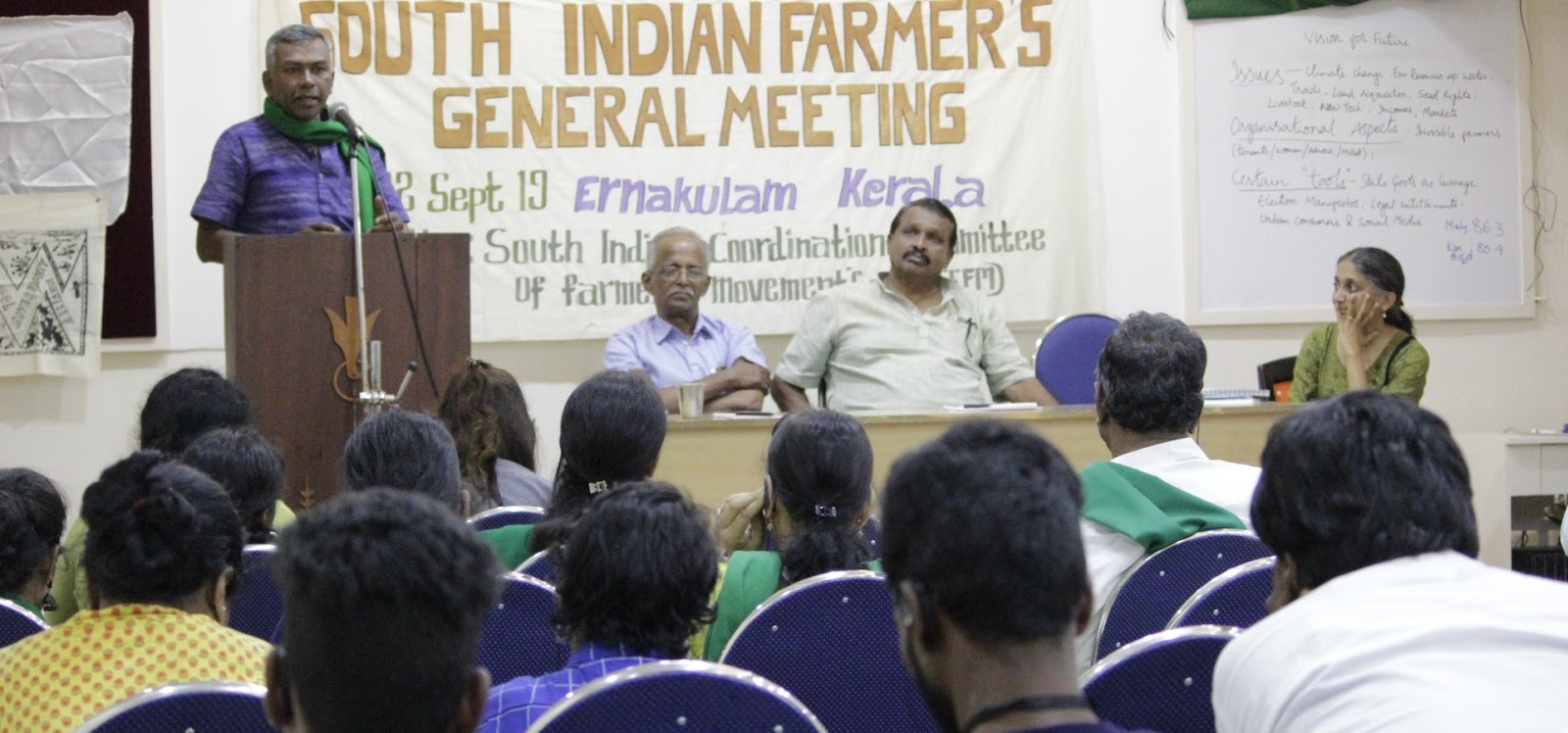
22nd September, Ernakulam: Member organizations and allies group associated under the banner of South Indian Coordination Committee of Farmers’ Movements (SICCFM) met at Ernakulam, Kerala to brainstorm and strategize collective action to address deepening agrarian crisis and evaluate the current policies adopted by the Indian government with respect to the free trade issues. The meeting was hosted by the Kerala Coconut Farmers' Association.


The two days round table meeting was attended by men, women, and youth representatives of farmers, indigenous and landless Dalit groups from the states of Karnataka, Tamil Nadu, Andhra Pradesh, Telangana, and Kerala. Researchers, academics and trade unionists who are also allies of the farmers' movements also took part in the two-day event.

It was evident from the meeting that all the south Indian states are undergoing similar struggles, the rise in farmers suicides, increasing costs of agricultural inputs, land grabbing by the Government and companies in the name of development, loss of traditional crop varieties, corporate take over of food and milk and effects of climate change in the form of prolonged drought and erratic rainfall patterns which caused devastating floods in Kerala and Karnataka in recent years.

During the two day meeting, a lot of emphasis was placed on understanding the impact of global free trade agreements on Indian agriculture and the participants scrutinized several ongoing negotiations and developments taking place inside and outside the World Trade Organisation (WTO) in this regard. In particular, the movement representatives analyzed the ongoing negotiations around RCEP, the Regional Comprehensive Partnership Agreement, comprising India and 15 other nations.

Discussing on the trade-related issues, representatives raised concerns against the unjust trade regimes dominated by a few big countries like the US, Australia and the EU.

"Indian government cannot trade away the lives of our farmers through getting into free trade agreements. For Indian farmers, agriculture is not just their profession. It is their culture, their life. Free trade has caused many market failures and has taken away the lives of many thousand farmers since the time India adopted the neoliberal trade reforms.", said Ravindranath of the Kerala Coconut Farmers' Association, while introducing the issue in the plenary.

The movements also took a decision to unanimously reject the RCEP free trade agreement.

"India is the world’s biggest milk producer and it's dairy sector provides critical revenue to farmers especially during poor crop years. Indian farmers earn more money from the sale of milk than from wheat and rice combined. About 80 million Indian rural households are engaged in milk production which provides a livelihood to poor and small farmers", reminded Yudhvir Singh of Bhartiya Kisan Union.

"Our farmers have already faced the negative effects under WTO and if India signs the RCEP pact, our farmers livelihoods will be under grave threat, said Sellamuthu of TVS, while raising concerns about the lack of transparency and consultation with farmers' movements in the country when a trade agreement of such a massive scale is being negotiated.

Chukki Nanjundaswamy expressed concerns saying, ‘apart from the dairy sector, RCEP poses threat to dilute our national legislations related to seeds and land acquisition, the RCEP will give an upper hand to seed corporations to steal our seeds and grab our natural resources. The most important point here is that the government has not consulted farmers while making decisions regarding agriculture in RCEP. We need support for agroecology at the policy level and we don’t need these mega FTAs in agriculture, we will intensify our fight against RCEP in the coming days.

Farmers in India have already borne the brunt of existing FTAs such as the ASEAN-India FTA and India Sri-Lanka FTA. Cheap imports of palm oil, pepper and tea have devastated the lives of peasants across South India. The RCEP will further aggravate this crisis. We reject the RCEP outright,” said Badagalapura Nagendra, President KRRS (Karnataka Rajya Raitha Sangha)

Kavita Kuruganti of ASHA said, RCEP is a large, looming, dangerously-real threat hanging on Indian farmers' lives. It is close to being signed and we need to stop it and save our Indian agriculture.

"RCEP will be detrimental to the plantation and fisheries sectors of Kerala, the state government of Kerala has already written to the central government opposing RCEP and asking the government to consult the state government before it inks final pact.", reminded Ravindranath

Referring to the proposed amendments to the Seed Bill, Rakesh Tikait, national spokesperson of BKU, expressed his concerns that it will give more powers to the multinationals to introduce GM and patent our farmers' seeds.  At a time when farmers in India are on the verge of destruction due to the failure of this government, by bringing a Bill that is against the farmers, the government is forcing us to commit suicide.

Referring to the unjust clauses under WTO, Kannaiyan Subramaniam said that ‘Rich countries wrote the Agreement on Agriculture in the WTO to favor themselves. Agribusiness corporations in rich countries receive huge subsidies that distort international prices. They want to dump their agriculture products in our countries and want us, farmers, to go out of business and depend on them for food. We have been fighting against WTO and now we will also intensify our fight against RCEP and we demand that Agriculture must be taken out of the WTO and RCEP.

Dairy provides subsistence income to many rural households especially the marginal farmers, opening domestic markets to dairy will wipe out small scale livestock keepers, especially women, said Murugamma of Food Sovereignty Alliance.


In the matter of Fair and Remunerative price for the resource-poor Indian sugarcane farmers, the Government of India has been sued by Guatemala, Brazil, and Australia in the Dispute settlement mechanism in the World Trade Organisation(WTO) and the investigation is pending in WTO. If Government of India allows cheaper sugar Imports, it will wipe out Indian sugar cane farmers from farming. RCEP will further cause damages to the sugarcane farmers and domestic sugar industries.

KV Rajkumar of South Indian Sugar cane farmers association said that, India has over 50 million sugar cane farmers and 2 million mill workers. Sugar mills owe more than 24000 crores to farmers who have supplied sugar cane. Sugar factories in Tamil Nadu have the dues to the tune of 1854 crores.

Selvaraj and Sobha, representatives of Adivasi groups from Neelagiris opposed the attack on the Rights of Tribals and Forest Dwellers and demanded that all the indigenous people and forest dwellers who are the original owners and depend on the forests and hilly areas for their life culture and livelihood should be protected and no eviction should take place under any guise, including the rejection of claims under the Forest Rights Act.

The representatives present in the meeting also made a decision to intensify the struggle against the RCEP through coordinated national action and protest against the RCEP and FTAs, a delegation of farmers will also try to meet the Prime Minister and Commerce Minister. Also, the farmers' groups planned to seek the interventions of the respective state governments to send a letter opposing the RCEP.

Wednesday, December 13, 2017

Indian Farmers attending World Trade Organization Ministerial in Buenos Aires warn government to take agriculture out of WTO

11 Dec 2017,  Buenos Aires: Indian farmers attending the World Trade Organization’s 11thMinisterial Conference from 10 to 13 December in Buenos Aires are demanding the Indian government and its delegation led by Commerce and Industry Minister, Suresh Prabhu, to defend India’s food security and the livelihoods of millions of poor consumers and farmers. They warn Prabhu to not give in to rich country demands of ending India’s public food stockholding program and farmer subsidies which they deem as trade distorting.


India’s National Food Security Program currently covers up to 75% of the rural population and 50% of the urban population [1] and provides targeted subsidies to the poorest Indian’s especially women and children. At the same time, in order to maintain adequate food stocks for the program, the government supports Indian farmers by procuring certain grains from them at fixed and subsidized prices called Minimum Support Prices (MSP)[2].

While the MSP is quite low and doesn’t even cover the cost of production by farmers, developed countries still demand even these low and life-supporting subsidies to be removed. On the other hand farmers in developed countries continue to receive enormous subsidies. In India, the move towards dismantling the food security program has already begun, subsidized ration shops in some Union Territories have been closed [3].

At the WTO’s Bali ministerial in 2013 countries had decided on a peace clause until a permanent solution was found, whereby action would not be taken against countries breaching subsidy limits for their public stockholding programs[4]. Now rich countries are imposing all kinds of conditions upon the permanent solution which would make it difficult for developing counties to fulfil and maintain their food distribution programs [5].


Yudhvir Singh of the Indian Coordination Committee of Farmers' Movements (ICCFM) and representing farmers from across India said, “India must not entertain any new issues like e-commerce or conditions or compromises on any allied issues until the permanent solution is resolved.” Rakesh Tikait of Bharatiya Kisan Union (BKU) said, “Indian farmers are committing suicide because of poor incomes, now they want to cut even this very low support that is keeping us farmers and the hungry from dying.”


S Kannaiyan, convener of the South Indian Coordination Committee of Farmers’ Movements(SICCFM) said, “Rich countries wrote the  Agreement on Agriculture in the WTO to favour themselves. Agribusiness corporations in rich countries receive huge subsidies which distort international prices. They want to dump their agriculture products in our countries and want us farmers to go out of business and depend on them for food. Agriculture must be taken out of the WTO.”

Farmers representing millions of farmers across India protesting inside MC11 at Buenos Aires
Another farmer from the Karnataka Rajya Raitha Sangha(KRRS), Gopal Papegowda said, “The Government should expand our Public Distribution Program to include pulses, oilseeds, millets, and vegetables which will benefit our farmers and poor consumers instead of dismantling it.”
Sellamuthu, of the Tamizagha Vyavasayagal Sangham(TVS) said “We have travelled far to fight for our basic right to an honest dignified livelihood. The Indian government cannot let us down this time. Giving in to the demands of the corporate controlled WTO will mean the sure death of the Indian farming community which is already reeling under severe agrarian distress.”

The farmers represent some of the largest farmers’ networks in India have been accredited to attend the WTO Ministerial Conference as Civil Society representatives of the international peasants’ movement, La Via Campesina [6].

Contact information for interviews: -

Yudhvir Singh, ICCFM: -+91-9868146405; Email: yudhvir55@yahoo.com (English, Hindi)
Rakesh Tikait, BKU -+91-9219666799; Email: bku.tikait@gmail.com (Hindi)
Gopal Papegowda, KRRS: +91-9900198894 (Kannada)
Sellamutthu, TVS :+91-9443855667 (Tamil)
S Kannaiyan, SICCFM : +91-9444989543; Email: sukannaiyan69@gmail.com (English, Tamil)

Notes:

[3] http://www.downtoearth.org.in/news/why-india-needs-to-fight-for-food-security-at-wto-59310: “According to the information provided by the Ministry of Consumer Affairs, Food and Public Distribution in Lok Sabha (Lower House of the Parliament of India) on July 25, 2017, all the ration shops in Chandigarh and Puducherry have been closed. These two union territories were used to be allocated 91,584 tonnes of food grains for distribution among 857,000 consumers. This has been stopped from the year 2017-18 and replaced by direct cash transfers,” instead of procuring from Indian farmers.
[4] http://www.thehindubusinessline.com/economy/at-wto-india-to-play-hardball-on-peace-clause/article9968851.ece: “According to the peace clause negotiated by India at the Bali meet in December 2013, no action will be taken against India, or other developing countries, in case the subsidies on their food procurement programmes breach the ceiling of 10 per cent of value of food production laid down by the Agreement on Agriculture”
[6] La Via Campesina is an international movement bringing together millions of peasants, small and medium size farmers, landless people, rural women and youth, indigenous people, migrants and agricultural workers from around the world. La Via Campesina comprises 164 local and national organisations in 73 countries from Africa, Asia, Europe and the Americas. Altogether it represents about 200 million farmers. (https://viacampesina.org/en/)

Friday, October 27, 2017

Indian farmers denounce UN Seed Treaty’s attempts to hand over people’s seed heritage to private companies

26 Oct, New Delhi: More than 50 Indian Farmers’ groups from the Indian Coordination Committee of Farmers Movements (ICCFM) [1],  have expressed concern over the proceedings of the International Treaty on Plant Genetic Resources for Food & Agriculture (ITPGRFA) [2] in a letter submitted to Mr. R. K. Singh, the Treaty’s national focal point in India today [3].Farmers claim there was no national consultation process at India level and demands for an urgent meeting with the farmers community before the next round of negotiations.

The UN Treaty is up for discussion at the 7th Governing Body (GB) session scheduled between 30th October and 3rd November 2017 at Kigali, Rwanda.

As the Indian government prepares to present its position at this important conference, farmers’ groups are disappointed that the Government has not communicated it's statement with them or asked for any suggestions, despite the fact that the Treaty makes it mandatory for farmers to be an integral part of the decision-making process.

Under its aims to promote conservation and sustainable use of plant genetic material for food and agriculture, the Treaty established a Global Information System on Plant Genetic Resources by collecting seeds from across the world,to provide farmers, scientists and the private sector access to the same.Much of the exhaustive collection of the Treaty’s seed banks, the Multilateral System, is held by the Consultative Group on International Agricultural Research (CGIAR), which farmers say is a known lobby-group for the world’s largest agri-businesses and GMO companies.

"These seeds are a public heritage that farmers have developed over millennia.Apart from the bio-piracy threat posed by CGIAR, the Treaty is now considering digitalizing the genetic information of the seeds in these seed banks which will make it easier for private companies to patent native genetic information, which will mean a certain death of the Treaty" said Tanmay Joshi, of Nagpur Beejotsav Gat and Shetkari Sanghthan.

Though there is a clause that any commercial benefits arising out of the use of these materials should be shared with the countries where they have originated, there is no legally binding obligation. Indian farmers are thus made even more vulnerable in this era of rampant bio-piracy practiced by large agri-businesses.

Farmers groups are dissuading the Government from entering into any collaboration with the multilateral Global Information System or the DivSeek programme, both of which are aimed at dematerialising peasant seeds by converting it into data of their genetic information, until stronger provisions are made for safeguarding their rights over seeds and against intellectual copyrighting.

“We hope that our concerns are well heard and acted upon. Upholding the democratic principles that lie within our constitution, we expect and request our Government representatives to have prior discussions with us before presenting at international conferences. Our seed security is at stake”, said Yudhvir Singh, convener of the AICCFM.

India is a megadiverse nation of rich plant genetic heritage with thousands of varieties in each food crop species. Many of these native crops have proven traits against the effects of climate change like droughts, floods, submergence and salinity. Efforts should be taken to protect, preserve and promote their cultivation without any risks of private patent restrictions. The Kigali Conference will determine whether India’s food sovereignty and the natural rights of our food producers can be protected at the global level.

Contact Information for Interviews
1.      Yudhvir Singh– +91-9868146405; Email: yudhvir55@yahoo.com
2.      Tanmay Joshi– +91-8087502186; Email:  tanmay_sg@gmail.com

Notes
[1] The Indian Coordaintion Committee of Farmers movements is a national alliance of mass based farmers movements formed in early 1990s and comprises of big farmers movements such as Bhartiya Kisan Union, Karnataka Rajya Raitha Sangha, The Tamilaga Vyavasayigal Sangam, Shetkari Sanghatna and Kerala Coconut Growers Association . Collectively they represent more than 300 million farmers nationally.

[2] The objectives of the International Treaty on Plant Genetic Resources for Food and Agriculture are the conservation and sustainable use of all plant genetic resources for food and agriculture and the fair and equitable sharing of the benefits arising out of their use, in harmony with the Convention on Biological Diversity, for sustainable agriculture and food security. See: http://www.fao.org/plant-treaty/en/

[3] Mr. R.K. SINGH is the Indian focal point for the treaty -
Department of Agriculture and Cooperation
Joint Secretary (Seeds)
Krishi Bhavan
New Delhi - India
Phone Number: +91 1123389241
Fax Number: +91 1123387669
Email Address: 
jsseeds-agri@nic.in

Tuesday, February 23, 2016

Corporate vision of the future of food promoted at the UN

Press release – La Via Campesina, ETC and Grain

(Rome, Monday 15 February, 2016) Just when the biotech companies that make transgenic seeds are merging, the corporate vision of biotechnology is showing up at FAO. At today’s opening of the three-day International symposium on agricultural biotechnologies convened by the Food and Agriculture Organization of the United Nations (FAO) in Rome, more than 100 civil society and social movement and organizations (CSOs) from four continents have issued a statement denouncing both the substance and structure of the meeting, which appears to be another attempt by multinational agribusiness to redirect the policies of the UN agency toward support for Genetically-engineered crops and livestock. 
The global peasant and family farm movement, La Via Campesina, invited CSOs to sign the letter when the symposium’s agenda became public.  Two of the FAO keynote speakers are known proponents of GMOs, and the agenda and side events over the three days include speakers from the Biotechnology Industry Organization (a biotech trade group in the USA), Crop Life International (the global agrochemical trade association), DuPont (one of the world’s largest biotech seed companies) and CEVA (a major veterinary medicine corporation), among others. FAO has only invited one speaker or panellist openly critical of GMOs.  Worse, one of the two speakers at the opening session is a former assistant director general of FAO who has pushed for so-called Terminator seeds (GMO seeds programmed to die at harvest time forcing farmers to purchase new seeds every growing season), in opposition to FAO’s own public statements. The second keynoter’s speech is titled, "Toward Ending the Misplaced Global Debate on Biotechnology" – suggesting that the FAO symposium should be the moment for shutting down biotech criticism.
In convening the biased symposium, FAO is bowing to industry pressure that intensified following international meetings on agroecology hosted by FAO in 2014 and 2015.  The agroecology meetings were a model of openness to all viewpoints, from peasants to industry. But the biotech industry apparently prefers now to have a meeting they can control.  This is not the first time FAO has been drawn into this game. In 2010, FAO convened a biotechnology conference in Guadalajara, Mexico, that blocked farmers from its organizing committee, and then tried to prevent their attendance at the conference itself. 
"We are alarmed that FAO is once again fronting for the same corporations, just when these companies are talking about further mergers amongst themselves, which would concentrate the commercial seeds sector in even fewer hands" the CSO statement denounces. 
It is clear, according to the Civil Society Statement, that industry wants to use FAO to re-launch their false message that genetically engineered crops can feed the world and cool the planet, while the reality is that nothing has changed on the biotech front. GMOs don't feed people, they are mostly planted in a handful of countries on industrial plantations for agrofuels and animal feed, they increase pesticide use, and they throw farmers off the land. Transnational biotech companies are trying to patent the planet's bodiversity, which shows that their main interest is to make enormous profits, and not to guarantee food security or food sovereignty. The industrial food system that these companies promote is also one of the main drivers of climate change. Confronted with the rejection of GMOs by many consumers and producers, the industry is now inventing new and possibly dangerous breeding techniques to genetically modify plants, without calling them GMOs. In doing so, they are trying to avoid current GMO regulations and trick consumers and farmers. 
The agroecology activities were much closer to the way that FAO should act, the Statement points out, "as a centre for knowledge exchange, without a hidden agenda on behalf of a few." Why does FAO now limit itself again to corporate biotechnology and deny the existence of peasant technologies? FAO should support the peasant technologies, that offer the most innovative, open source, and the effective pathway to ending hunger and malnutrition. It is time to stop pushing a narrow corporate agenda, says Civil Society. "The vast majority of the world's farmers are peasants, and it is peasants who feed the world. We need peasant-based technologies, not corporate biotechnologies." 
"It is high time that FAO puts an end to biopiracy and to its support for genetically modified crops, which only serve to allow a handful of transnational companies to patent and to grab all the existing biodiversity," said La Via Campesina leader Guy Kastler. "On the contrary, FAO should support farmers' organisations and researchers engaged in collaborative plant breeding in the service of food sovereignty and peasant agroecology”.
The statement and the list of signatories can be downloaded here: http://goo.gl/mjaZor
Media contacts in Rome:
Guy Kastler and other Via Campesina leaders
Phone numbers: + 39 329 665 53 44 and +39 331 188 64 35